About Mosaic

A twelve years long experiment, honestly told.

Mosaic is a small piece of land in southern Portugal and a long conversation between the people who care for it. This page is not the brochure. It is where the project actually stands, what we have lived, what we broke, what we are repairing, and what we are slowly building into something that can last.

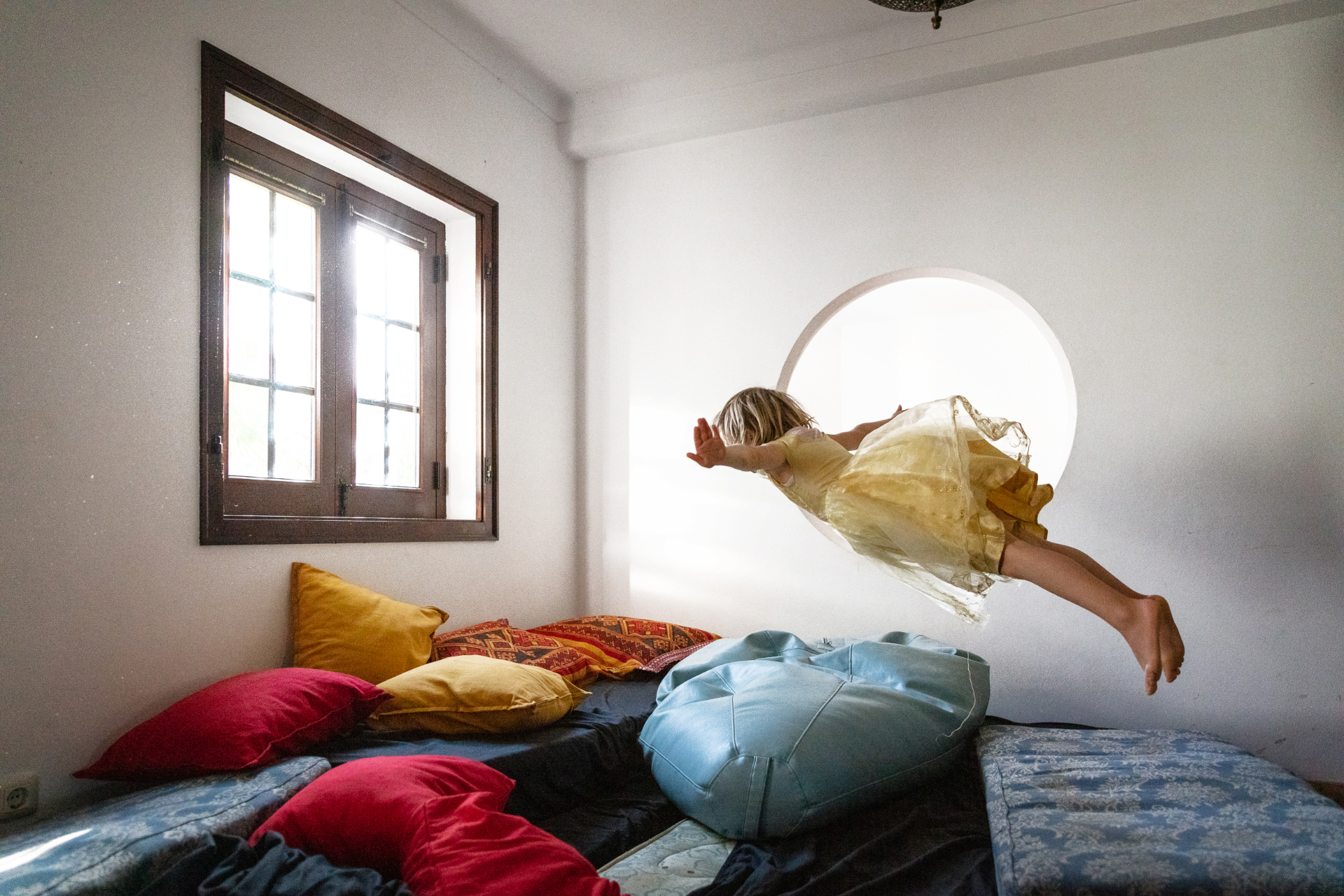
A child mid-jump in a golden dress above cushions in a sunlit Mosaic room

01

Where we are

Out of collapse, into a cooperative.

Most of what you see on this website, the vision, the practices, the land, the story, is real, and it is also part of a project that is in the middle of a significant transition. We want to be honest about that, because the next chapter of Mosaic depends on people meeting us as we actually are, not as we once imagined we would be.

For the first time in our history we are moving the land out of a classic private-ownership setup and into a cooperativa. The process took years and produced the most detailed set of agreements we have ever held, a slow distillation of everything we have learned about what kind of legal frame, what kind of governance, and what kind of human commitments are needed to hold a project like this in place over decades.

We are also coming out of four years of collapse. Not a collapse of the land or the buildings, those continued to be renovated, regenerated, used for workshops and trainings, but a collapse of the human structure underneath. It came from a mismatch and from the inability to stay in relationship through conflict. One of the people who chose to re-found the project overcommitted, and underestimated how much emotional intelligence, empathy and capacity-to-stretch a community setup of this kind asks for. Communities surface diversity and complexity almost by design; integrating them is work nobody fully prepares for.

Those years were not empty. The land kept being tended. The gardens kept growing. The workshops kept happening. Governance kept being researched, refined and rewritten. The offering kept being clarified, what the project needs from new people, and what new people would need to bring in order to create stable ground rather than another well-meaning fragility.

Today we are four people deeply committed, with a wider circle moving closer or waiting for the cooperative to be formalised before stepping in. Our intention for 2026 2027 is to grow into a core of seven or eight. We have specific financial obligations toward early investors which we are able to meet without forcing the project into unrealistic scenarios. And we are giving ourselves a six-year horizon to truly stabilise: new investors, new stewards, diversified revenue, diversified offerings, education, and a deeper integration of the regenerative work.

In short: Mosaic is not a finished community. It is a project learning, in public, how to come back into form after a hard cycle, slower, clearer, and with much better agreements.

02 — Commitments

What we actually agree to practice.

If we distill Mosaic — not as an eco-village, not as a community, but as a relational, regenerative and governance laboratory — what follows is less about ideals and more about the commitments through which we want to work.

The implicit agreement behind all commitments

Mosaic is not a place that promises comfort, certainty, belonging, or freedom. It is a place that offers an opportunity to develop the capacities through which those qualities become possible:

  • — Greater self-awareness
  • — Greater relational intelligence
  • — Greater responsibility
  • — Greater capacity for cooperation
  • — Greater capacity to steward land, resources, and power
  • — Greater capacity to remain in relationship with reality

In that sense, joining Mosaic is less like joining a community and more like entering a dojo: a place where the practice is learning how to become capable of building coherent human culture.

03 — Paradoxes

The living paradoxes of Mosaic.

Polarities we hold not as conflicts to resolve, but as interdependent forces that strengthen and balance one another.

04 — An honest invitation

What we are actually inviting you into.

Most people are not looking for community.

They are looking for the feeling they imagine community will give them:

Belonging. Support. Meaning. Connection. Purpose. Family.

We understand this. We long for these things too.

But after more than ten years of living, building, failing, repairing, and learning together, we have discovered something important:

These qualities do not emerge because people gather on land.

They emerge because people become capable of creating them.

And that is a very different journey.

Mosaic is not primarily an eco-village, a retreat centre, a co-living project, or an alternative lifestyle experiment. It is a place where we are attempting to learn what it takes to build coherent human culture.

That means you will encounter beautiful things here:

Connection. Friendship. Laughter. Shared meals. Meaningful conversations. Nature. Celebration. Creativity.

And the rare feeling that life can be lived differently.

But you will also encounter things that are less romantic:

  • Your resistance to responsibility.
  • Your relationship with power.
  • Your assumptions about money.
  • Your expectations of others.
  • Your fear of commitment.
  • Your difficulty receiving feedback.
  • Your tendency to withdraw when things become uncomfortable.
  • Your longing to belong alongside your fear of truly being seen.

Sooner or later, everyone who stays long enough encounters these things. Not because anyone is trying to teach them a lesson. Because collective life reveals them naturally.

Community is often imagined as an escape from modern society.

Our experience is almost the opposite. Community becomes a magnifying glass.

The patterns that remain hidden in ordinary life become visible.

The places where we are free become visible.

The places where we are not become visible as well.

For this reason, Mosaic is probably not a good fit if you are looking for a place that will adapt itself entirely to your needs, protect you from discomfort, or allow you to participate only when it feels convenient.

At the same time, it is not a place where people are expected to sacrifice themselves for the collective. We are not interested in self-abandonment. We are interested in learning how individual wellbeing, collective wellbeing, and service to the wider world can become increasingly aligned.

This requires honesty, humility, and a willingness to discover that reality may have something to teach us that our identity does not want to hear.

What we are looking for are not perfect people.

We are looking for people who are willing to learn. People who can take responsibility. People who can stay in relationship when tensions arise. People who are curious about the gap between the life they imagine and the life they are actually creating. People who are willing to participate in building something larger than themselves.

If this sounds exciting, inspiring, and slightly uncomfortable at the same time, then there is a good chance you understand what we are trying to do.

05

Timeline

Our story so far.

More than a decade of building, breaking, repairing and learning together. This is not a success story, it is the unfolding journey of a project slowly finding its shape.

  1. 2026

    Re-alignment and the cooperative

    A new core team begins gathering with stronger alignment. The land begins its transition out of private ownership into a cooperative, the most detailed set of agreements the project has ever held.

  2. 2025

    Foundational work under pressure

    Refining financial models, agreements and development strategies, while navigating an important transition with a former partner.

  3. 2024

    Structuring and preparation for renewal

    Structural work intensifies. By the end of the year a growing sense of potential rebirth is felt.

  4. 2023

    Reconstruction and reorganisation

    Rebuilding internal structure and governance. The focus is on stabilising the organisation rather than rapid growth.

  5. 2022

    Collapse and emotional integration

    Renovation plans are interrupted by the exit of a partner and misalignment within the team. After a structural collapse mid-year, focus shifts to emotional repair rather than expansion.

  6. 2021

    Major ecological infrastructure & structural transition

    A major ecological expansion alongside transformation of the organisational structure. Both lands are transitioned into a company structure.

  7. 2020

    Resilience under global disruption

    During the pandemic the project shifts into a quieter rhythm with more local Portuguese participation. Meditation, gardening and daily life become central.

  8. 2019

    Healing and land development

    Healing and embodiment practices become more present. Garden areas develop to prepare for more serious food production.

  9. 2018

    Consolidation and community life

    Intense communal living and experimentation. Infrastructure grows; relational dynamics become an explicit part of the learning.

  10. 2017

    Ecological systems and deeper practice

    Ecological systems expand while the social field deepens. Conscious relating and personal development become more visible.

  11. 2016

    Expanding the learning field

    A broader range of workshops begins. Connections with Berlin bring a stronger flow of facilitators and participants.

  12. 2015

    Establishing the base

    A year of physical groundwork and first shared spaces. Many people pass through; early collaborators arrive.

  13. 2014

    Permalab is founded

    Two initiators and five financial contributors start an experimental laboratory for regenerative land stewardship and new forms of community life.

What's next

Some questions are too important to leave to books, podcasts and theories. They deserve to be lived.

If something in this honest version of Mosaic resonates, as a future resident, a steward, an investor, or simply a curious companion to the project, we would like to hear from you.